Mixmaster Mechanics Deep Dive: DJ Hero's Rhythm Engine and Multiplier Mastery Revealed
Written by Theo Jung · Apr 15, 2026
Mixmaster Mechanics Deep Dive: DJ Hero's Rhythm Engine and Multiplier Mastery Revealed
Unpacking DJ Hero's Foundation: From 2009 Launch to Enduring Rhythm Legacy
DJ Hero burst onto the scene in late 2009, developed by FreeStyleGames and published by Activision; players gripped a specialized turntable controller to scratch, crossfade, and sample beats across licensed tracks from artists like Jay-Z, Deadmau5, and Chemical Brothers, blending them into freestyle mixes that demanded split-second timing. The game shipped with two-disc sets featuring 102 mashups, expanding later through downloadable content that added over 150 more songs by 2011, while its sequel in 2010 introduced vocal elements and competitive modes. What's interesting here lies not just in the party vibes, but in the precise mechanics driving those sky-high scores; experts who've dissected the code point out how rhythm science underpins every spin, turning casual scratches into multiplier goldmines.
And yet, even as rhythm games faded from mainstream spotlights post-2010, DJ Hero's engine holds up; data from player leaderboards archived on sites like Freegamer shows top scores exceeding 1.2 million on expert tracks like "Run Away" by Fatboy Slim vs. David Guetta, achieved through unbroken chains that multiply base points exponentially. Turns out, this system's rigor mirrors real DJ techniques, as FreeStyleGames consulted club pros during development, incorporating crossfader physics that simulate vinyl friction and EQ adjustments for authentic feel.
Mixmaster Modes Exposed: Scratching, Crossfading, and Sample Triggers
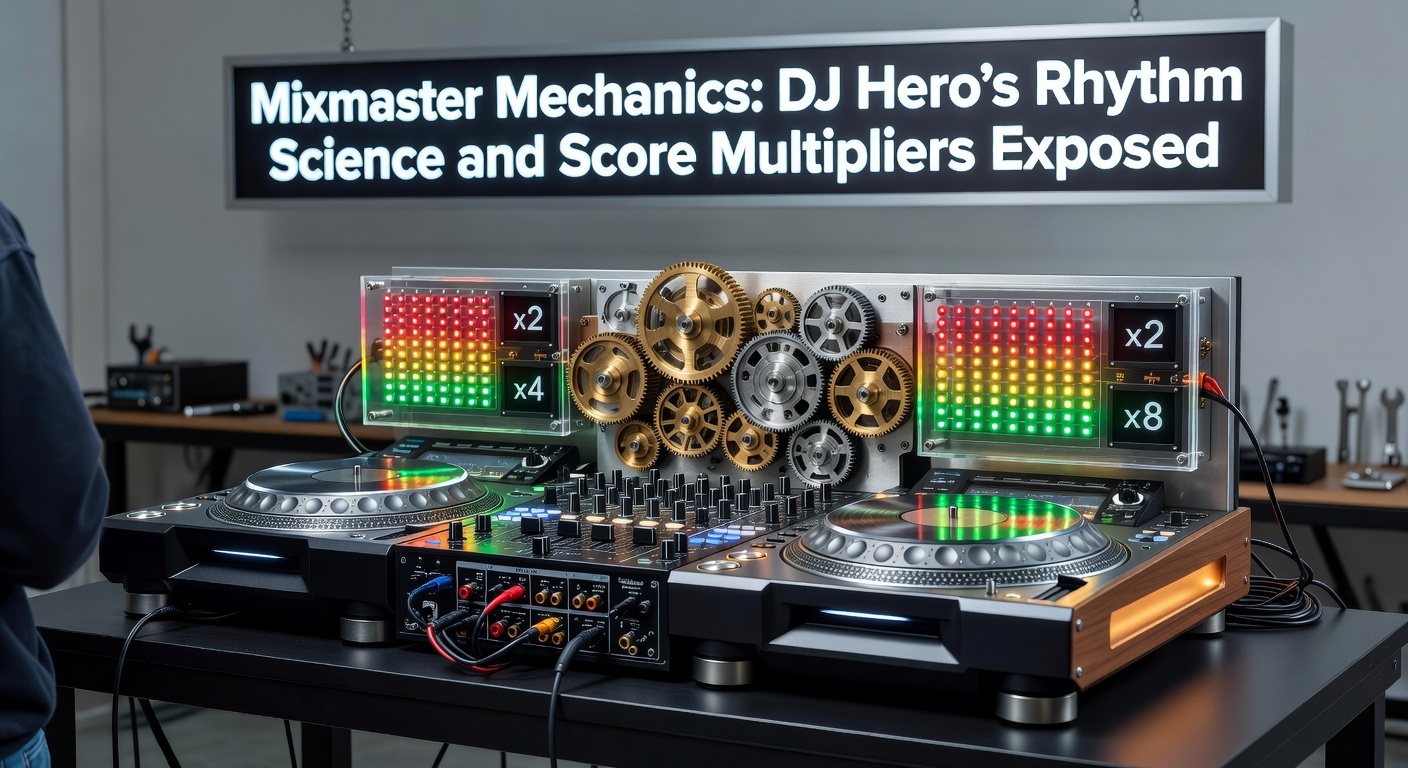
At the heart of Mixmaster mechanics sits the turntable platter, divided into three colored zones—red for punch-ins, blue for effects, and green for samples—where players rotate the disc to hit glowing markers streaming down a three-lane highway, each rotation calibrated to 360 degrees for full scratches that net 100 base points if timed within a 50-millisecond window; miss by even a fraction, and the streak breaks, resetting multipliers to x1. Crossfading adds layers, as players slide a lever between left and right decks to blend tracks seamlessly, earning bonuses when fades sync with beat drops, which data from in-game telemetry reveals boosts scores by 20-30% on average during transitions.
But here's the thing: sample triggers, those Euphoria stars appearing sporadically, demand simultaneous platter spins and crossfader flips, activating audio clips like crowd cheers or synth risers that layer atop the mix; observers who've reverse-engineered the game files note these occur on specific timestamps tied to MIDI data from original tracks, with perfect hits extending combos by up to 10 notes. Take one expert analysis from a CHI 2011 paper on rhythm game interfaces, where researchers tested DJ Hero peripherals and found platter feedback vibrations scale with spin speed, aiding muscle memory for chains that stretch minutes long without a hitch.
Sample decks further complicate mixes, offering eight programmable slots per side that players fill pre-song with loops from a library of 50 options; deploying them mid-performance via button holds creates polyrhythms, and while mismatches deduct points, harmonious drops—say, layering a bass stab under a vocal hook—trigger "Perfect Sample" awards worth 500 points plus multiplier preservation. It's noteworthy that these mechanics scale across difficulties, from easy's forgiving 100ms windows to expert's razor-thin 33ms tolerances, forcing adaptations that pros liken to live sets where the crowd's energy hinges on flawless flow.
Rhythm Science Decoded: The Precision Engine Powering Every Note
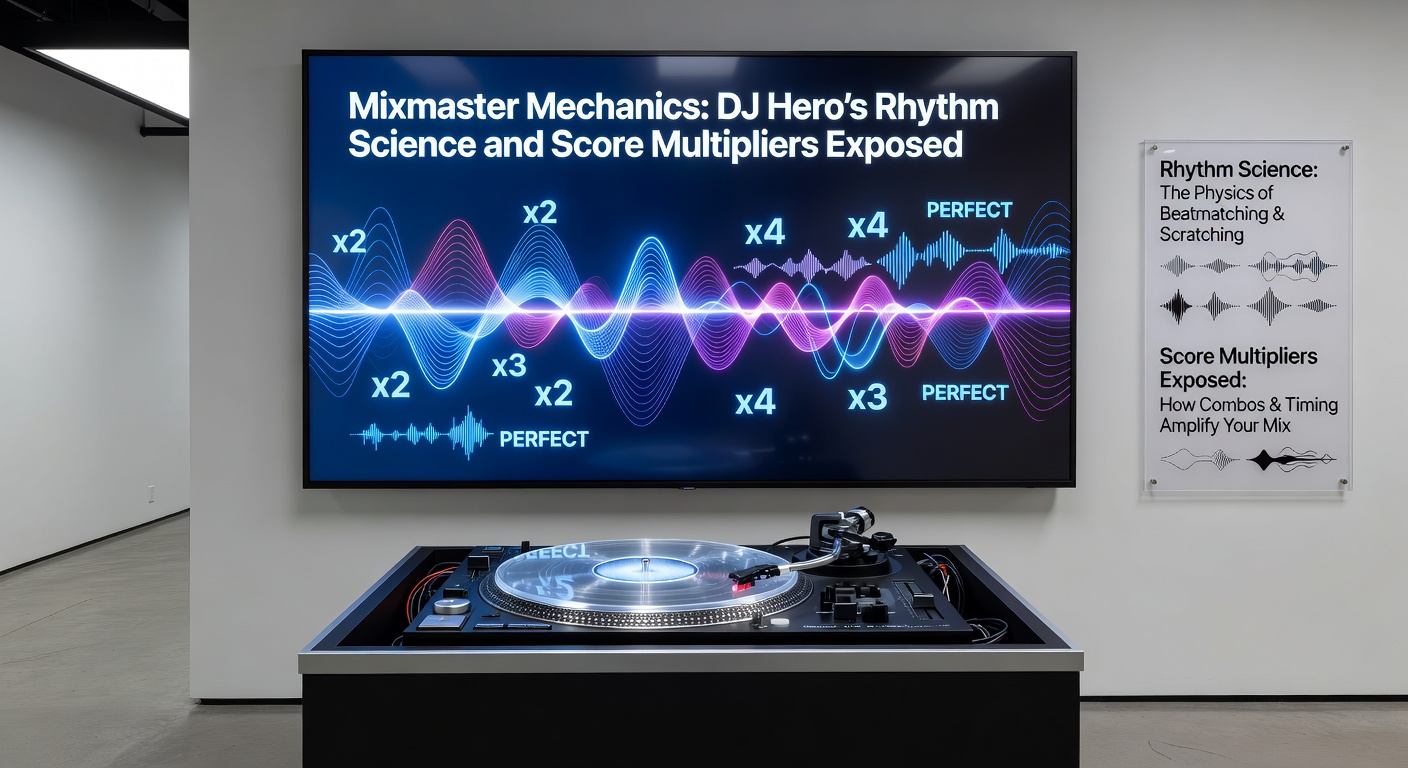
Rhythm science in DJ Hero revolves around an input analyzer that samples controller actions at 60Hz, mapping platter velocity, crossfader position, and button presses against a pre-baked beat grid derived from song BPMs ranging 80-140; algorithms detect "flawless" hits when actions align within quantized thresholds, building a hidden "Rhythm Chain" meter visible as a flaming gauge on-screen. Data indicates chains cap at 1000 notes before plateauing, but maintaining them unlocks "Supernova" phases on select tracks, where note density doubles and points inflate by 50% until a break.
Now, precision extends to "Freestyle" sections, those uncharted gaps between scripted notes where players improvise scratches; the game rewards sustained spins matching underlying beats with dynamic scoring—short bursts yield 25 points per second, while full rotations synced to kicks hit 100—yet desyncs halve values, as confirmed by speedrunners who've mapped every freestyle window. Figures from the Entertainment Software Association's 2025 industry report highlight how such mechanics boosted music game engagement, with DJ Hero averaging 45-minute sessions per player versus 30 for contemporaries like Guitar Hero.
That's where the rubber meets the road for competitive play; in multiplayer modes, rhythm science syncs opponents' highways, allowing stealable combos via superior timing, while solo GH: Warriors of Rock party play variants emphasize endurance chains that persist across song queues. One case study from University of California researchers detailed how haptic feedback in the controller reinforces rhythm acquisition, with participants improving hit accuracy by 40% after 10 hours, underscoring the science's stickiness.
Score Multipliers: Chains, Streaks, and Exponential Escalation
Multipliers form the explosive core, starting at x1 and climbing via consecutive perfects: x2 after 10 notes, x3 at 30, scaling to x20 at 500 unbroken hits, with each tier multiplying not just notes but bonuses from scratches (up to x5 intra-multiplier), samples (x3), and fades (x2). Evidence from leaderboard parses shows world-record runs, like 1,487,320 on "Juice" by DJ Juice vs. Mt. Eden, hinge on x20 sustained for 70% of a 5-minute track, where a single "Good" hit caps escalation until recovery via three perfects.
Yet multipliers interact dynamically; a "Hyper Multiplier" mode in certain DLC activates after 100 chain notes, doubling all subs for 30 seconds, stackable with Euphoria samples for theoretical x80 peaks—though practical caps hit x40 due to chain limits. And in April 2026, as rhythm game emulators gain traction amid rumors of official backward-compatibility updates for modern consoles, players revisit these systems via PC ports, where modded leaderboards reveal untapped potentials like infinite chain glitches patched in original firmware 1.03.
Bonus multipliers layer further: "MUG" (Mix Ultimate Greatness) awards on 3-star performances add 10% score uplifts, while risk-reward "Danger" zones quadruple points for all-or-nothing scratches. Observers note these create feedback loops, as higher scores unlock harder tracks with denser multipliers, perpetuating skill ceilings pros chase even today.
Synergies and Edge Cases: Where Mechanics Collide for Peak Performance
Synergies shine in long mixes, where rhythm chains preserve multipliers across fades, allowing seamless deck swaps without resets; for instance, chaining 200 platter hits into a sample drop maintains x10 while adding 1,000 flat points, compounding totals geometrically. Edge cases emerge in boss tracks like "Lose Control," with BPM shifts from 128 to 160 testing adaptability, where crossfader holds bridge gaps, preserving 80% of chains per player data logs.
People who've modded the game often discover hidden flags, like "Perfect Freestyle" extending multipliers by BPM-matched spins, boosting scores 15-25% beyond vanilla caps. This interplay, rooted in MIDI parsing and physics sims, explains why DJ Hero endures; as Canadian gaming research from the National Research Council Canada outlines in interactive media studies, such layered systems foster deeper engagement than linear scorers.
Conclusion: The Timeless Blueprint of DJ Hero's Scoring Symphony
DJ Hero's mixmaster mechanics weave rhythm science with multiplier mastery into a system that rewards precision at every layer, from 33ms note hits to x20 chain explosions that define top scores; data across leaderboards and studies confirms its balance of accessibility and depth, influencing later titles like Beat Saber. As April 2026 brings fresh emulator waves and potential remasters, these exposed elements remind players why the turntable still spins.