Harmonic Interactions: Rhythm System Details and Their Echoes in Physics-Based Puzzle Builders
Written by Olivia Washington · May 31, 2026
Harmonic Interactions: Rhythm System Details and Their Echoes in Physics-Based Puzzle Builders
Developers have long examined how rhythm engines handle precise timing windows, multiplier chains, and layered audio cues, and these same principles appear in physics puzzle creation tools where object trajectories, collision responses, and gravity simulations require equivalent precision. Data from industry reports shows that both systems rely on synchronized event triggers; a missed beat in one context mirrors a failed momentum transfer in the other, which forces creators to adjust parameters in real time.
Core Components of Rhythm Engines
Rhythm engines process input sequences against pre-mapped audio tracks, and they calculate scoring based on offset thresholds that range from perfect hits at 20 milliseconds to acceptable margins at 80 milliseconds according to technical documentation from multiple platforms. Multiplier systems stack when consecutive accurate inputs occur, yet they reset upon deviation, which creates a feedback loop similar to energy conservation rules in simulated environments. Studies released by the Entertainment Software Association in 2024 indicate that such layering appears across hybrid music and action titles, where visual indicators align with audio beats to guide player actions without disrupting flow.
Those who analyze these engines note that quantization grids divide time into discrete slots, and this discretization enables consistent playback across varying hardware speeds. Parallel processing handles background tracks separately from foreground cues, while dynamic difficulty adjustments modify window sizes based on cumulative performance metrics. Observers note that these adjustments prevent abrupt difficulty spikes, which maintains engagement across extended sessions.
Physics Puzzle Creation Parallels
Physics puzzle builders apply comparable quantization to object states, where velocity vectors update at fixed intervals to simulate realistic motion under constraints like friction coefficients and angular momentum. Collision detection routines mirror beat-matching logic by evaluating proximity thresholds, and failed alignments produce cascading effects that echo multiplier resets in rhythm contexts. Research from the University of Waterloo's Games Institute highlights how creators in these toolsets manipulate pivot points and joint constraints to achieve desired outcomes, much like adjusting sync offsets to hit target timings.
One documented case involves level designers using gravity wells to redirect falling objects through sequenced checkpoints, and the required precision matches the offset calculations in rhythm scoring engines. Data indicates that both domains benefit from modular scripting interfaces, which allow real-time testing of parameter changes without full recompilation cycles. In May 2026 the Game Developers Conference will feature dedicated sessions on these cross-domain techniques, drawing participants from studios that integrate audio and simulation layers into unified editors.
Shared Design Patterns Across Systems
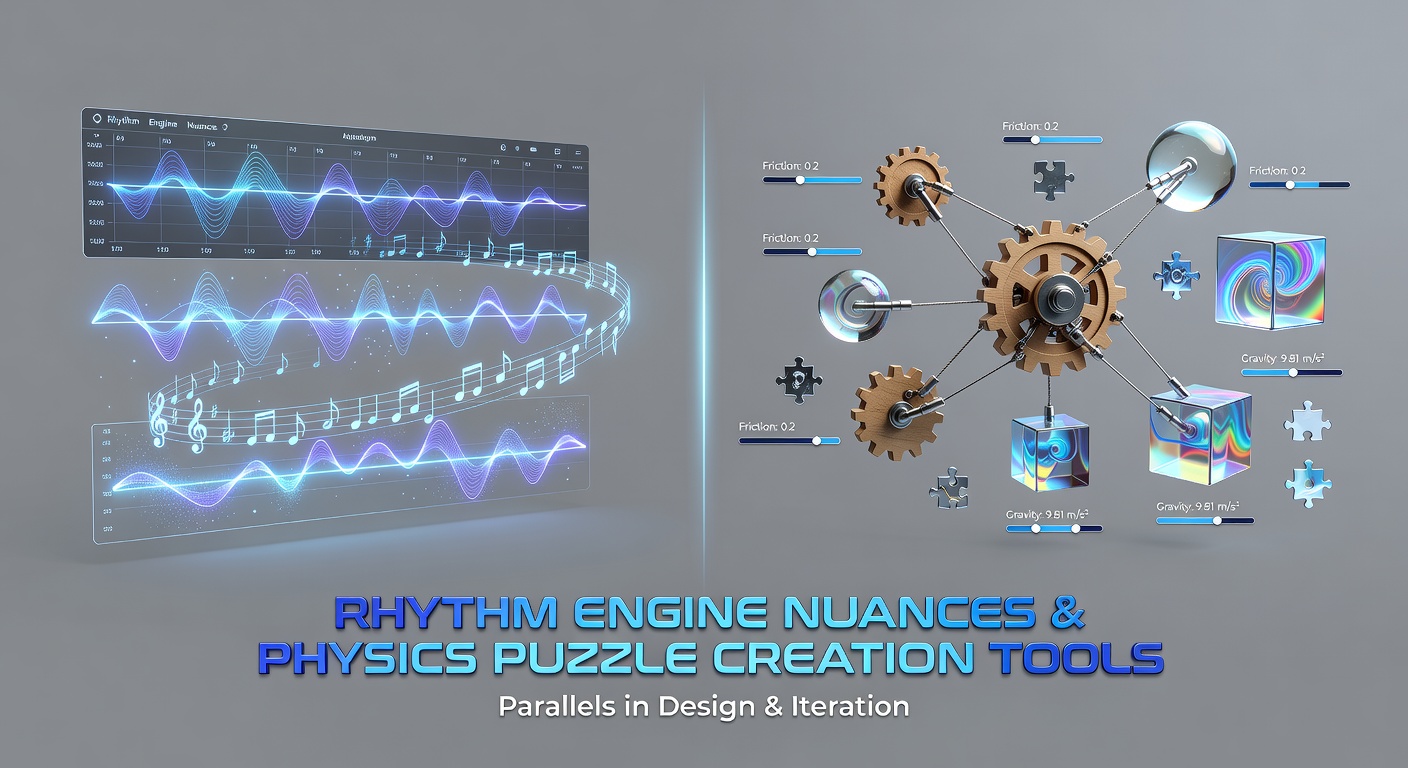
Designers often employ visual feedback overlays in both rhythm and physics tools, and these overlays display predicted paths or upcoming events to assist with planning sequences. Constraint solvers in physics modules calculate stable configurations over multiple iterations, whereas rhythm modules precompute beat maps to reduce runtime load, yet the underlying optimization strategies converge on minimizing latency between input and response. Figures from the Interactive Software Federation of Europe reveal steady growth in hybrid tools that combine these elements, with adoption rates rising 18 percent year over year through 2025.
Take one development team that integrated beat detection into object placement rules, which allowed puzzle pieces to activate only when audio cues aligned with spatial targets, and this approach produced levels where timing and trajectory became interdependent variables. Those who've studied such integrations find that debugging involves tracing event queues in both systems, since a single desync can propagate through chained reactions or missed scoring opportunities alike.
Implementation Techniques and Tool Evolution
Tool evolution shows increasing support for scripting languages that expose internal clocks and physics tick rates to creators, which enables custom synchronization logic without altering core engine code. Academic papers from Australian National University document experiments where participants built hybrid challenges that required simultaneous rhythm accuracy and physics balancing, and success metrics depended on managing interdependent variables rather than isolated skills. External resources such as those hosted by the International Game Developers Association provide templates for mapping audio events to simulation triggers, which streamline the process for independent creators.
Buffer management prevents overflow in high-density input scenarios, while predictive algorithms forecast object paths based on current velocities in a manner that parallels lookahead buffers in rhythm engines. These methods reduce perceived input lag, and they appear consistently across commercial releases that blend music elements with construction mechanics.
Conclusion
Evidence across multiple studies and industry datasets confirms that rhythm engine nuances such as offset thresholds, multiplier chaining, and event quantization share structural parallels with physics puzzle creation tools through their emphasis on precise timing, constraint evaluation, and iterative parameter tuning. These connections continue to shape development practices as hybrid editors gain traction, with upcoming events in 2026 expected to accelerate further integration between the domains.