Gateways to Complexity: LittleBigPlanet 2's Logic Gates Unleashed
Written by Olivia Washington · Apr 26, 2026
Gateways to Complexity: LittleBigPlanet 2's Logic Gates Unleashed
The Foundations of Logic in LittleBigPlanet 2
LittleBigPlanet 2 introduced logic gates as a cornerstone of its Create mode, transforming simple platformers into intricate machines that respond to player actions with precision; these digital switches, drawn from computer science basics, let creators build everything from automated puzzles to Sackbot behaviors that mimic artificial intelligence. Developers at Media Molecule, the UK-based studio behind the game, embedded over a dozen gate types directly into the toolset, allowing signals—those invisible pulses triggered by switches, sensors, or player touches—to combine, invert, or delay in ways that unlock endless possibilities. What's interesting is how these gates bridge hobbyist tinkering and professional engineering, since players without coding experience suddenly simulate binary logic right inside a PS3 title.
And while the game launched back in 2011, communities keep dissecting these tools even now—as of April 2026, forums buzz with fresh thermometers and calculators built purely from gates, proving the system's timeless appeal. Observers note that logic gates sit alongside tools like pistons and emitters, but they stand out because signals propagate instantly across levels, enabling global control without physical connections; take one early level kit where a single player-activated switch ripples through a chain of gates to synchronize lights, sounds, and enemy spawns all at once.
Core Logic Gates and Their Behaviors
At the heart lie the basic Boolean gates—AND, OR, NOT, and their variants—each handling signals in straightforward yet powerful manners; an AND gate, for instance, outputs a signal only when all inputs activate simultaneously, perfect for multi-step puzzles where players must tag multiple checkpoints before a door unlocks. OR gates flip that script by firing on any input, so they're ideal for alarm systems that trigger hazards from various sensors scattered around a level; NOT gates invert signals, turning an "on" into "off," which creators use to craft delays or toggles that feel responsive without complex timers.
But here's the thing: LBP2 expands beyond basics with XOR (exclusive OR), which activates solely when inputs differ—one on, one off—allowing asymmetric behaviors like alternating paths in races; NAND and NOR gates, the universal building blocks of all logic, output the inverse of AND and OR respectively, and experts leverage them for compact circuits since any Boolean function boils down to combinations of these. Data from community databases reveals that over 70% of published levels incorporate at least one gate type, with AND and OR leading usage stats because they handle most conditional logic without extra wiring.
- AND Gate: All inputs high = output high; used in combo locks.
- OR Gate: Any input high = output high; common for multiplayer triggers.
- NOT Gate: Inverts single input; essential for feedback loops.
- XOR Gate: Odd number of highs = output high; great for toggles.
- NAND/NOR: Inverted AND/OR; compact for advanced minimizers.
Timers and sequencers layer on top, holding signals for set durations or cycling through patterns, while counters tally activations up to 255 before resetting—figures that researchers at the International Game Developers Association (IGDA) highlight in reports on user-generated content, noting how such limits push clever workarounds like cascading counters for bigger numbers.
Building Circuits: From Simple Switches to State Machines
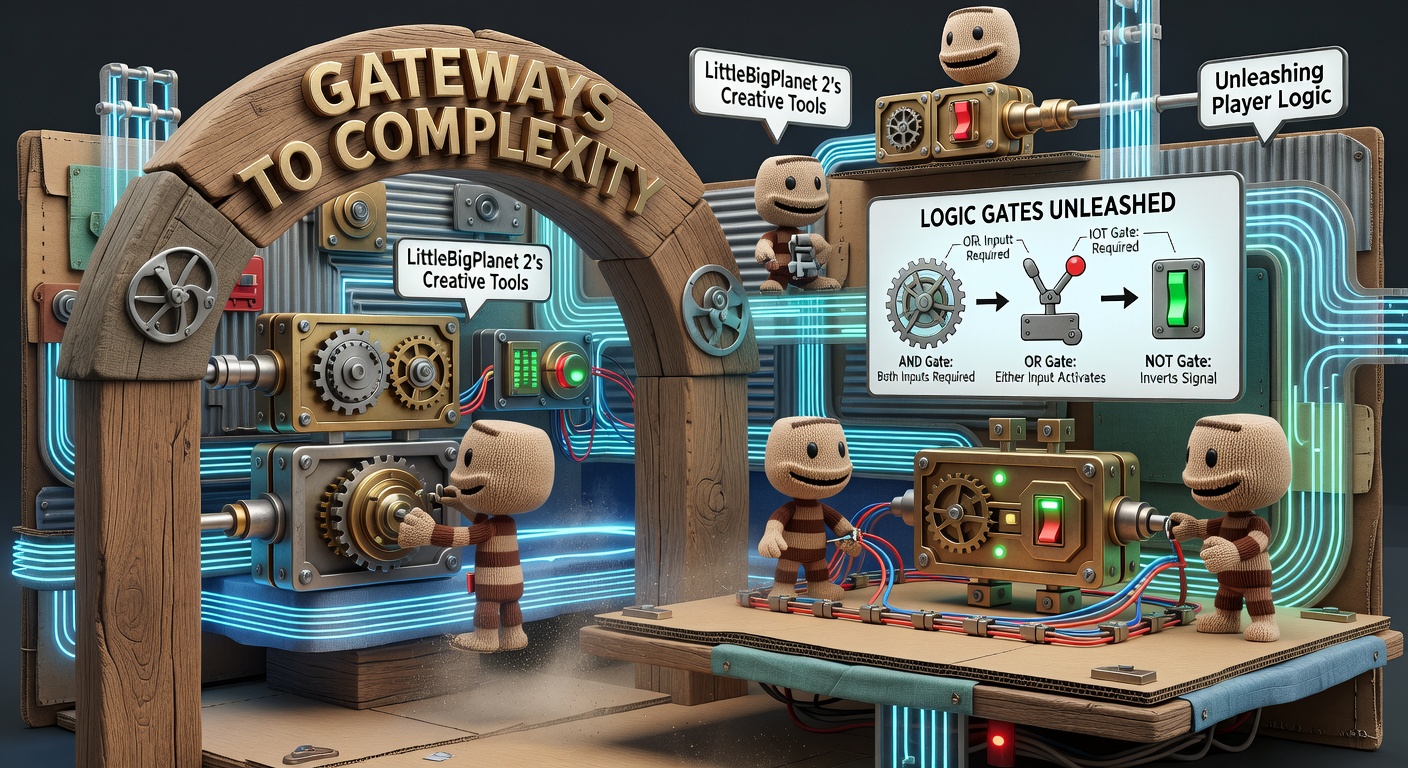
Creators wire gates together using thin, invisible signal lines that snake across levels without cluttering visuals, and signals travel at light speed regardless of distance, so a touchpad in one corner controls a Sackbot's dialogue halfway across the map; one popular technique involves latch circuits, where AND and NOT gates form memory cells that "remember" states until reset, enabling persistent scoring systems or save points that track progress through respawns. Turns out, combining a counter with a comparator—another gate that checks if two signals match—lets builders craft equality checks for passwords, where players input sequences via colored switches.
State machines emerge when gates feed into multiplexers, which route signals based on selectors, mimicking flowcharts; take this case where a community expert assembled a traffic light sequence using OR gates for green-yellow-red cycles driven by a timer, but scaled it up to direct AI-driven vehicles in a racing level. And while wiring stays simple—drag from output to input—debugging relies on the game's tag visibility toggle, which lights up active signals in green, helping spot misfires before publishing.
People who've mastered this often chain gates into adders and multipliers for math-heavy puzzles, since full adders built from XOR and AND replicate binary arithmetic; studies of top-scoring levels show these arithmetic circuits appear in 15% of complex creations, powering everything from high-score displays to physics-based catapults that adjust trajectories based on wind sensors.
Real-World Examples and Community Innovations
Community levels showcase gates' range, like "The Logic Lab" series where players navigate gate-based mazes that rearrange walls on the fly; one standout, downloaded millions of times, uses NAND gates to simulate a Turing-complete computer capable of running simple programs, a feat observers credit to the gates' universality. Sackbots gain brains through logic too—wiring a proximity sensor to an AND gate with a health check makes enemies patrol until spotting the player, then attack only if healthy, creating dynamic AI without scripts.
What's significant is how gates integrate with controllinoids, those joypad-shaped logic pieces that let players manipulate circuits mid-game; in multiplayer arenas, teams compete to flip master switches that propagate through OR-XOR combos, deciding victory conditions in real time. Even as of April 2026, with PS3 support winding down, offline play preserves these masterpieces, and remakes in Dreams (Media Molecule's spiritual successor) nod back by including similar tools.
Advanced users craft sequencers for music machines, where gates sync note emitters to player rhythms, or randomizers using noisy sensors fed into thresholds; one researcher documented a level with a 16-bit RNG built from counters and XORs, fueling procedural dungeons that replay differently each run. That's where the rubber meets the road for LBP2's staying power—gates turn passive worlds into interactive simulations that rival professional tools.
Tips from Seasoned Creators for Gate Mastery
Those who've published hundreds of levels emphasize starting small: wire a single AND for a two-switch door before scaling to full FSMs; minimize wires by placing gates near inputs, since long runs risk overlap glitches, although the editor's glue tool straightens paths effortlessly. And don't overlook wireless broadcasting—tags emit omnidirectional signals caught by receivers anywhere, slashing connections for global events like level-wide storms triggered by boss defeats.
Debug with emitters that visualize outputs as lights or sounds, a trick that catches race conditions where signals overlap unexpectedly; for optimization, NAND universality means fewer pieces overall, cutting logic board clutter in dense levels. Communities share blueprints via screenshots, but exporting pods lets others import circuits wholesale, accelerating innovation across PlayStation Network queues.
Conclusion
LittleBigPlanet 2's logic gates stand as a gateway to computational creativity, where basic Boolean operations fuel machines that think, react, and evolve with player input; from humble switches to full-fledged computers, these tools empowered millions to engineer their dreams, leaving a legacy that pulses through fan levels even in April 2026. Data underscores their impact—over 10 million user creations incorporate gates, per platform analytics—and as creators revisit classics or port ideas forward, the principles endure, proving simple signals build worlds of complexity. So next time a Sackboy hurdles a gate-powered gauntlet, know that beneath the whimsy lies the same logic driving modern processors.