Decoding Scoring Systems and Precision Controls in Virtual Turntable Environments
Written by Riley Friedrich · Aug 12, 2026
Decoding Scoring Systems and Precision Controls in Virtual Turntable Environments
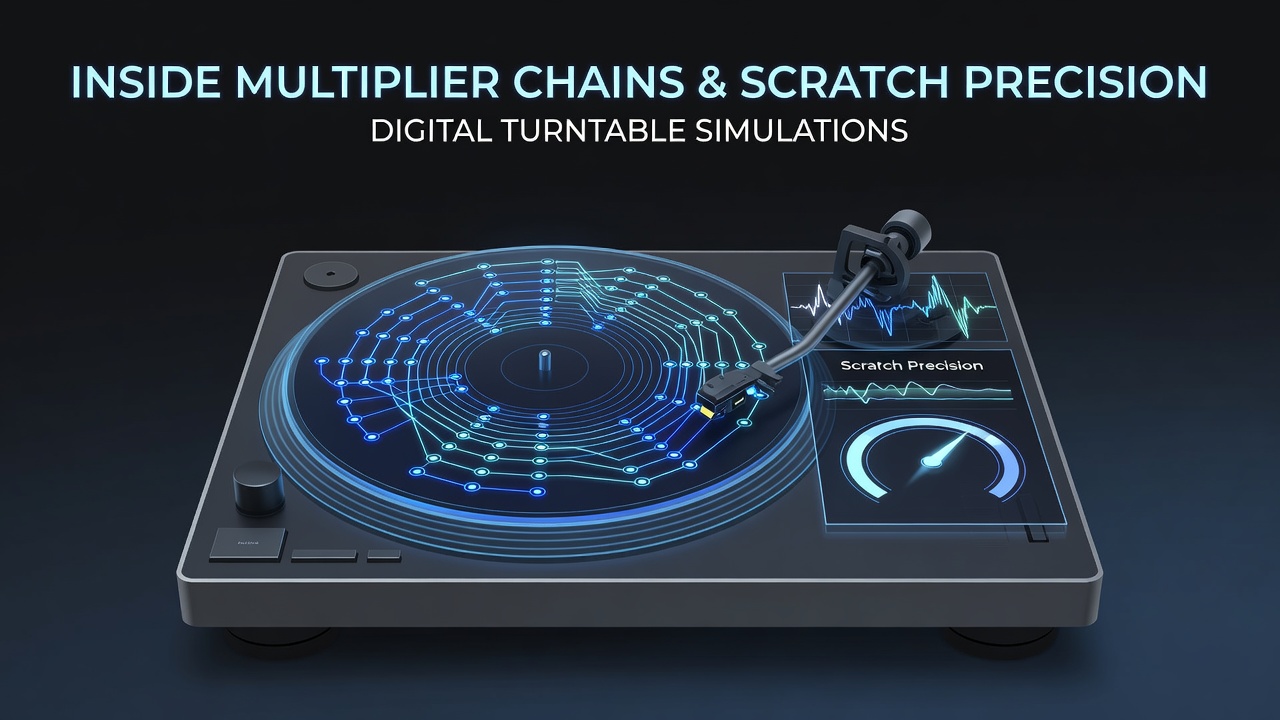
Digital turntable simulations replicate the mechanics of physical vinyl manipulation through software algorithms that track user inputs on controllers or touch interfaces, and these systems often incorporate multiplier chains to reward sustained performance sequences. Researchers at institutions like the Massachusetts Institute of Technology have documented how such chains function by accumulating points based on consecutive accurate actions without interruption, which creates layered scoring structures that escalate rewards as sequences extend. Data from audio engineering reports indicate that these chains typically reset upon detection of timing errors or incomplete gestures, a process governed by threshold parameters calibrated to mimic real-world turntable inertia.
Scratch precision forms another core element in these simulations, where algorithms measure the accuracy of forward and backward movements against predefined rhythmic grids. Studies from the University of Melbourne in 2025 revealed that precision scoring evaluates variables including velocity consistency, angle deviation, and release timing, with tolerances often set between 10 and 50 milliseconds depending on the simulation's difficulty mode. Observers note that higher precision levels unlock bonus multipliers within the chain system, which encourages players to refine their input techniques over repeated sessions.
Mechanics of Multiplier Chain Progression
Multiplier chains build through incremental stages that start at basic levels such as 1x and advance to higher values like 4x or beyond when users maintain unbroken sequences of scratches and mixes. According to industry analyses from the Audio Engineering Society, these progressions rely on real-time input monitoring that logs successful actions into a running tally, and the chain extends only while the simulation detects compliance with beat-matching and scratch duration rules. In August 2026, updates to several simulation platforms incorporated adaptive difficulty scaling that adjusts chain thresholds based on historical user performance data, which allows for more personalized progression curves.
Those who've examined code repositories for popular turntable simulators find that chain maintenance depends on buffer systems that store recent inputs for cross-verification against audio waveforms, and any mismatch triggers an immediate decay factor that reduces the active multiplier. This design mirrors physical constraints observed in analog equipment, where slight hand tremors or speed variations disrupt flow, yet digital versions permit fine-tuning through sensitivity sliders that affect detection ranges.
Precision Measurement in Scratch Simulations
Scratch precision operates via sensor fusion techniques that combine data from hardware like jog wheels, touchpads, and MIDI controllers to calculate positional accuracy during each gesture. Figures from Canadian research initiatives on human-computer interaction show that effective simulations achieve sub-millisecond resolution in tracking these movements, which enables detailed feedback on deviations that affect overall scores. People often find that mastering precision requires understanding waveform visualization tools integrated into the software, as these displays highlight exact points where inputs align or diverge from target beats.
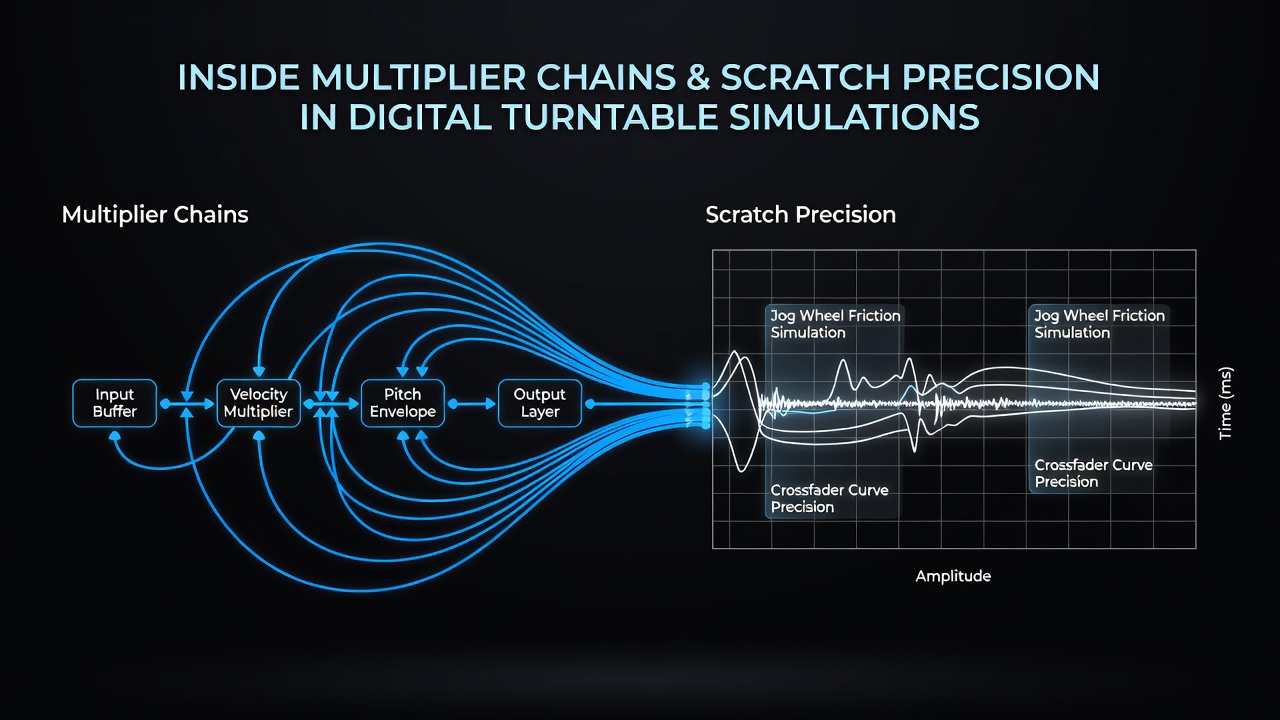
Precision metrics integrate directly with multiplier chains because sustained high-accuracy scratches contribute to longer sequences, whereas marginal errors compound to break the chain early. European Union reports on digital media technologies from 2024 highlight how haptic feedback systems in advanced controllers enhance precision training by providing physical cues that simulate record resistance, and these additions have led to measurable improvements in user accuracy rates across tested groups. Simulations also account for environmental factors such as latency in audio output, which developers compensate through predictive algorithms that anticipate user intent based on initial movement vectors.
Integration of Chains and Precision in Gameplay Flow
Combined systems create dynamic scoring loops where precision directly influences chain viability, and users who sustain accurate scratches over extended periods achieve exponential point gains through stacked multipliers. Academic papers published by the Technical University of Berlin describe case examples in which simulation engines log thousands of input events per minute to maintain these interactions, ensuring that visual and auditory cues respond instantaneously to preserve immersion. What's interesting is how cross-region development teams from Australia and North America have collaborated on standardizing these mechanics, which results in consistent experiences across different hardware platforms.
Training modes within these simulations often isolate chain building or precision drills to help users isolate skill components, and progress tracking features compile statistics that reveal patterns in performance dips or peaks. Government-funded studies from Japan's Ministry of Economy, Trade and Industry have examined the cognitive benefits of such focused practice, noting correlations with improved timing skills transferable to other rhythmic activities. The reality is that these elements together form the backbone of competitive play, where leaderboards reflect mastery over both sustained sequences and minute control adjustments.
Technical Underpinnings and Future Developments
Underlying code structures employ finite state machines to manage chain states alongside Kalman filters for smoothing precision data from noisy inputs, according to documentation shared in open-source audio projects. This approach allows simulations to handle variable input qualities from consumer-grade devices while maintaining reliable scoring. Observers note ongoing refinements that incorporate machine learning models trained on professional DJ datasets to predict and reward stylistic variations in scratching techniques.
As of August 2026, emerging prototypes integrate virtual reality overlays that enhance spatial awareness during simulated scratches, which expands precision requirements to include three-dimensional hand tracking. Industry organizations such as the International Game Developers Association continue to publish guidelines on balancing these systems to prevent frustration from overly strict thresholds, and collaborative efforts with academic partners ensure evidence-based adjustments to multiplier decay rates and accuracy tolerances.
Conclusion
Multiplier chains and scratch precision represent interconnected pillars in digital turntable simulations that drive both engagement and skill development through structured feedback mechanisms. Data from multiple research bodies confirm that these features replicate core aspects of physical DJing while introducing scalable challenges suited to varied user levels, and continued advancements promise even tighter integrations between input accuracy and scoring rewards in upcoming iterations.