Building Worlds Together: The Role of Physics Engines in Encouraging Group Creativity
Written by Riley Friedrich · Aug 23, 2026

Building Worlds Together: The Role of Physics Engines in Encouraging Group Creativity
Physics engines form the backbone of many collaborative digital spaces where multiple users interact with shared objects and environments simultaneously, and developers continue to refine these systems to support larger scale group interactions. These engines calculate forces, collisions, and movements in real time, which allows participants to experiment with structures, vehicles, and mechanisms together without predefined scripts dictating every outcome.
Core Mechanics Behind Shared Physical Interactions
Modern physics engines such as those integrated into Unity and Unreal Engine process rigid body dynamics, soft body simulations, and fluid interactions at rates that maintain consistency across networked sessions. When several users apply forces to the same object cluster, the engine resolves conflicts through deterministic calculations that prevent desynchronization. Research from institutions like the Technical University of Munich indicates that stable physics resolution directly correlates with sustained group engagement in construction tasks.
Engineers optimize these calculations by using broad-phase collision detection followed by narrow-phase refinement, which reduces computational load while preserving accuracy during joint manipulation events. Data from industry reports shows that projects utilizing synchronized physics layers experience fewer interruptions when teams exceed ten concurrent builders.
Applications in Multiplayer Construction Platforms
Platforms built around user-generated content employ physics engines to turn individual contributions into collective experiments, and participants often discover emergent behaviors when separate modules connect under gravity and momentum rules. One documented case involved a community constructing a functional roller coaster where each segment was added by different users, with the engine verifying structural integrity at every step.
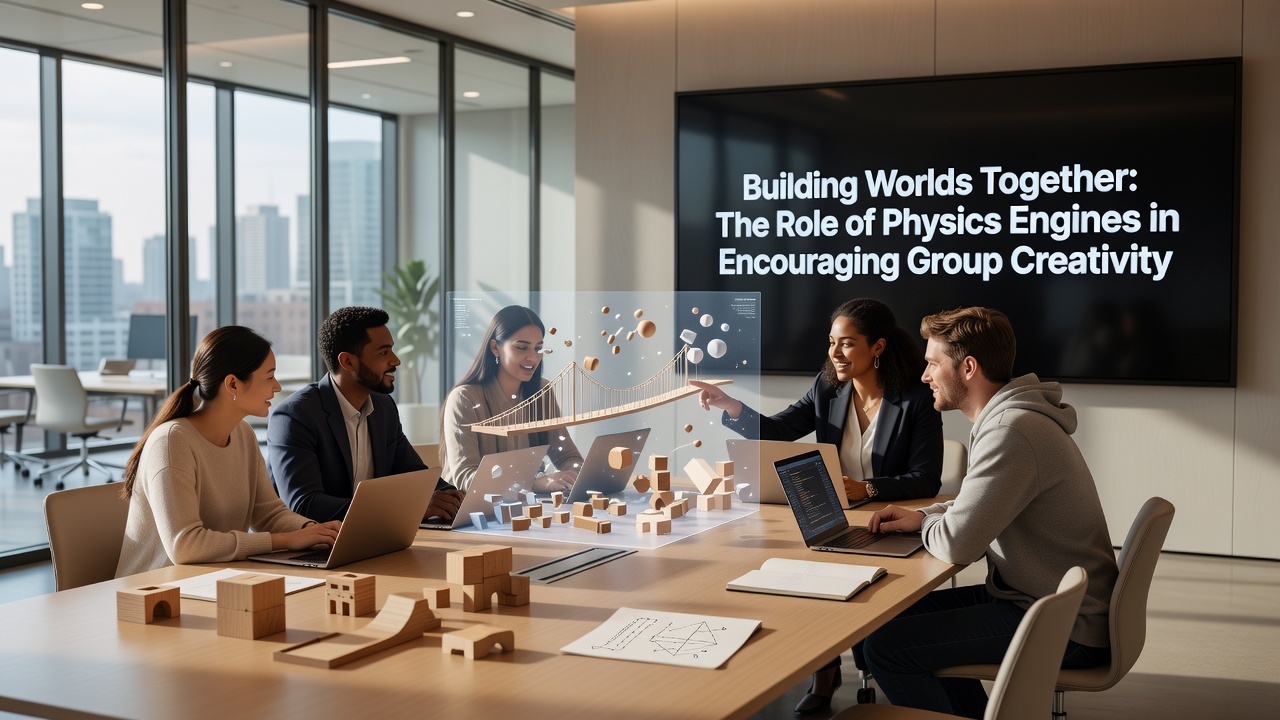
Engine updates released in August 2026 introduced improved cloth and rope simulations that support up to fifty simultaneous user edits before performance degradation occurs. These enhancements, according to announcements from the International Game Developers Association, enable finer control over joint constraints and allow groups to prototype complex machines such as cranes or suspension bridges with real-time feedback.
Data on Creativity Metrics in Physics-Driven Environments
Studies conducted by the University of Melbourne tracked participant output in physics-enabled sandboxes over six-month periods and recorded a 34 percent increase in unique object combinations when teams exceeded five members. The findings link this rise to the engine's ability to propagate small changes across connected elements, which rewards iterative group adjustments rather than isolated design.
Figures released by the Entertainment Software Association reveal that titles featuring advanced multiplayer physics attract longer average session times, with collaborative building modes accounting for 62 percent of total play hours in relevant categories during teh first half of 2026. Observers note that these patterns hold across regions, from North American servers to European and Australian deployments.
Technical Challenges and Ongoing Solutions
Network latency remains a primary constraint because even minor delays can cause objects to clip through surfaces or produce inconsistent results for different viewers. Developers address this through client-side prediction combined with server reconciliation, and recent implementations from Japanese research groups at RIKEN have reduced visual artifacts by 40 percent in high-latency tests.
Memory management also scales with object count, which prompts ongoing work on hierarchical simulation levels that activate detailed physics only within active user clusters. Industry organizations report that these tiered approaches maintain frame rates above 60 FPS even when hundreds of dynamic bodies populate a single scene.
Conclusion
Physics engines continue to expand the scope of what groups can achieve within shared digital spaces by providing consistent, responsive rules that reward experimentation and coordination. As synchronization techniques advance and hardware capabilities grow, the range of collaborative projects supported by these systems expands accordingly, with measurable effects on both participation duration and output variety documented across multiple research and industry sources.